
SEO vs. GEO, Explained: Why Ranking on Google No Longer Means You Exist to AI
Search Engine Optimisation (SEO) makes your brand visible on a results page a human scrolls through. Generative Engine Optimisation (GEO) makes your brand visible inside an answer an AI writes and hands over as fact. They sound like cousins. They are not. One is about winning a spot in a list; the other is about winning a mention in a sentence. Only one of them survives when there’s no list left to rank on.
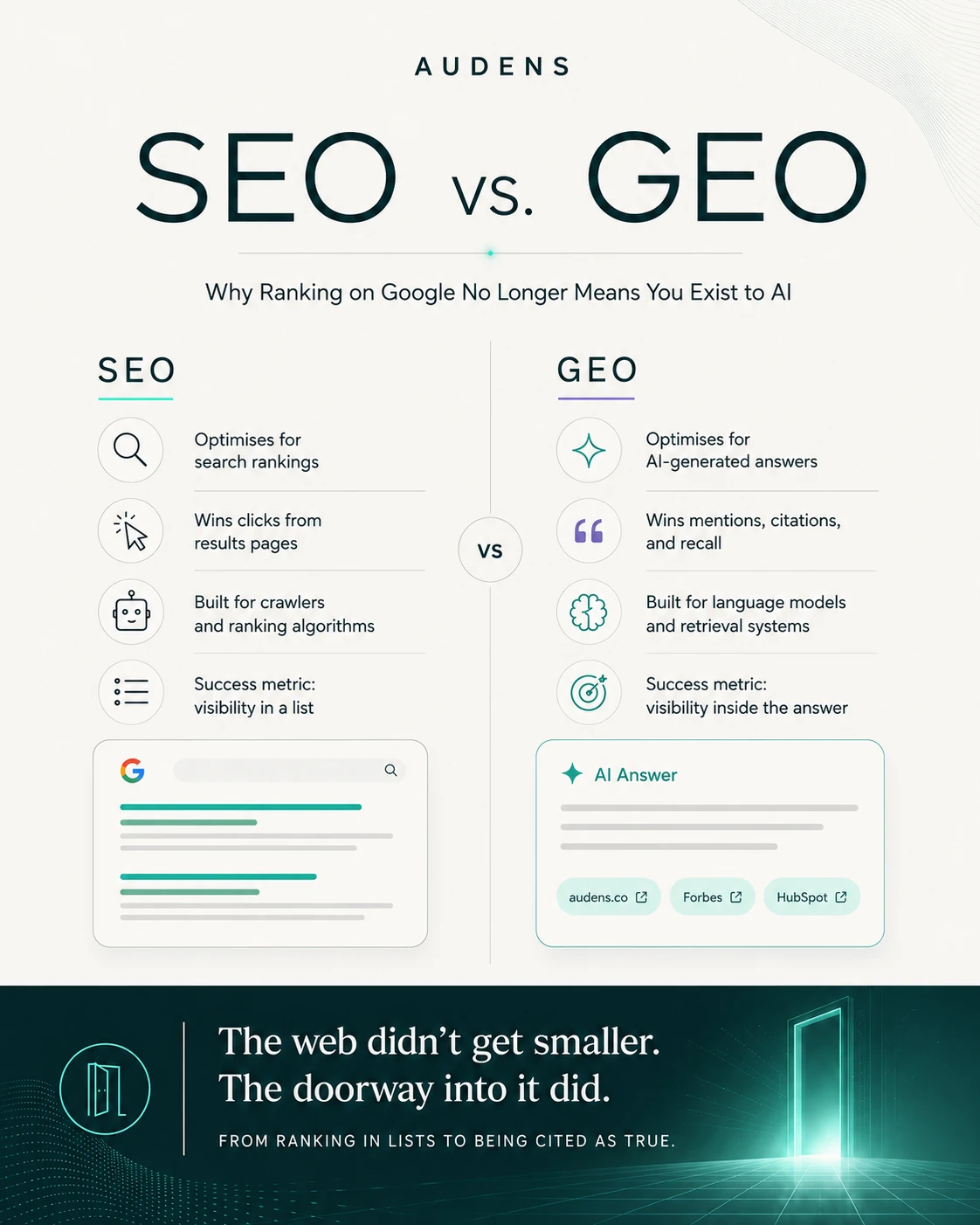
That distinction is where every conversation about “the future of search” should start, because most marketers are still optimising for a battlefield that’s quietly shrinking.
The Blue Links Were Never the Point
For twenty-five years, the unit of competition online was the link. Rank higher, get clicked, win the customer. SEO built an entire industry around reverse-engineering Google’s ranking logic: backlinks, keyword density, page speed, domain authority. It worked because the interface stayed constant: a search box, ten results, blue text.
Now picture someone opening ChatGPT, Perplexity, or Google’s AI Overview and typing “best moisturiser for oily acne-prone skin in Delhi summers.” They don’t get ten links. They get one paragraph, three brand names, and a recommendation, generated almost instantly. There’s no page two. There’s no “click here to learn more” unless the AI decides to include it. If your brand isn’t one of the names the model already trusts, you don’t lose a ranking; you lose the conversation entirely.
That’s the shift GEO exists to answer.
What GEO Actually Optimises For
SEO optimises for a crawler that indexes pages and a ranking algorithm that sorts them. GEO optimises for a language model that has already read the internet, formed a compressed “opinion” about your category, and now generates an answer from memory and retrieval rather than from a live results page.
Think of SEO as trying to get your restaurant into a printed city guide. You format your listing well, you get good reviews, you appear near the top of the “Italian Restaurants” section. GEO is different: it’s the difference between being in the guide and being the restaurant the concierge personally recommends without even checking the book, because he’s already formed a confident opinion about you from everything he’s read, heard, and remembered.
An AI model doesn’t “crawl” your brand in real time the way Google does. It has trained on a snapshot of the internet, and increasingly it retrieves live, specific facts through a process called RAG (Retrieval-Augmented Generation), essentially the model doing a quick lookup before it answers, similar to how a well-prepared student still glances at their notes before responding, even after months of studying. GEO is the discipline of making sure that when the model trains, remembers, or retrieves, your brand is the one it reaches for, with the correct facts attached.
The Basics, Named Properly
Since this is where a lot of teams are starting from zero, worth being precise about four terms that get used almost interchangeably, incorrectly:
GEO (Generative Engine Optimisation) is the umbrella discipline. It means making your brand appear, and appear accurately, inside AI-generated answers across all platforms: ChatGPT, Gemini, Perplexity, Copilot, AI Overviews.
AEO (Answer Engine Optimisation) is narrower: structuring content specifically to be extracted as a direct answer to a specific question. Every FAQ block, every “in short” summary line, every table that answers “which is better, X or Y” is AEO in practice.
LLMO (LLM Optimisation) refers to optimising specifically for how large language models are trained and fine-tuned, making sure your brand’s information exists in the training-adjacent web in a form that’s clean, consistent, and unambiguous enough to be absorbed correctly.
Schema markup is the technical plumbing beneath all three: structured code (like Product, FAQ, or Organization schema) added to a webpage that explicitly tells a machine “this is a price,” “this is a review score,” “this is the founder’s name,” instead of leaving it to infer that from paragraph text. Schema doesn’t guarantee an AI mentions you, but it removes the ambiguity that makes an AI hesitant to.
If SEO is writing so a human skims comfortably, GEO (with AEO and schema as its instruments) is writing so a machine can extract, verify, and quote you with confidence.
A Live Example: The Indian Skincare Market
At Audens, when we ran an AI-visibility assessment on the Indian skincare category, the pattern was immediate. Ask an AI model “what’s a good Indian skincare brand for oily, acne-prone skin,” and names like Minimalist and Mamaearth surface consistently, not because they necessarily rank #1 on Google for that query, but because their ingredient lists, claims, and positioning exist across the web in language that’s specific, consistent, and easy for a model to extract without interpretation. Meanwhile, category white space, like premium anti-aging for the Indian market, showed almost no confident brand recall at all. Not because no brand makes the product, but because none of them have been described online in a way a model can retrieve with certainty.
That’s GEO working, or not working, in the wild. It has nothing to do with backlinks. It has everything to do with whether the internet has told the model, clearly and repeatedly, who you are and what you’re for.
Why This Isn’t “SEO 2.0”
The instinct to call GEO “just the next version of SEO” undersells the shift. SEO assumes a human makes the final click-through decision after seeing options. GEO assumes the AI has often already made the decision on the human’s behalf, and the human is now just hearing the verdict. That moves the battle upstream, from “who gets clicked” to “who gets cited as true.”
This is also why GEO can’t be bolted onto an old content strategy as an afterthought. A blog written to rank on Google keywords and a blog written to be extracted, quoted, and trusted by a language model often need different structures entirely: the direct answer up front, semantic headers a model can parse as topic signals, and language specific enough that there’s nothing left to guess.
Where to Start, If You’re Starting Cold
Don’t try to conquer all four disciplines at once. Start by asking the AI models themselves what they currently say about your category and your brand. That single exercise usually reveals more than a quarter’s worth of SEO audits ever did. Then work backward: fix the ambiguity, add the schema, write the direct answers, and repeat the test.
The web didn’t get smaller. The doorway into it did. GEO is simply the discipline of making sure your brand is standing on the right side of that doorway when the model walks a customer through it.
Sources
- Lewis, P. et al., “Retrieval-Augmented Generation for Knowledge-Intensive NLP Tasks,” NeurIPS 33 (2020): foundational RAG paper, backs the retrieval explanation. arxiv.org/abs/2005.11401
- Pew Research Center, _“_Google users are less likely to click on links when an AI summary appears in the results," 22 July 2025, July 2025: organic click rate drops from 15% to 8% when an AI Overview appears. pewresearch.org/short-reads/2025/07/22/google-users-are-less-likely-to-click-on-links-when-an-ai-summary-appears-in-the-results/
- Ahrefs, "Update: AI Overviews Reduce Clicks by 58%," 4 February 2026 (December 2025 data, 300,000 keywords): 58% click-through drop for the top-ranking result when an AI Overview appears. ahrefs.com/blog/ai-overviews-reduce-clicks-update/
- Google Search Central, “Intro to How Structured Data Markup Works”: official documentation, backs the schema explanation. developers.google.com/search/docs/appearance/structured-data/intro-structured-data
Methodology: the Indian skincare example draws on AUDENS’ own AI-visibility assessment, run across major generative engines using named-brand and category prompts.