
AEO vs GEO, Explained: Why a Single Optimisation Mechanic is not the Only Answer
Ever asked a parent a simple question and instead of answering concisely, they give a whole long story with references, context and backstory? They are not wrong, and some of it might even be relevant to the question you originally asked but, would it not have been so much easier if they had just given you a straightforward answer. Such is the differentiating case between what Answer Engine Optimisation(AEO) and Generative Engine Optimisation(GEO) aim to achieve with their synthesised replies.
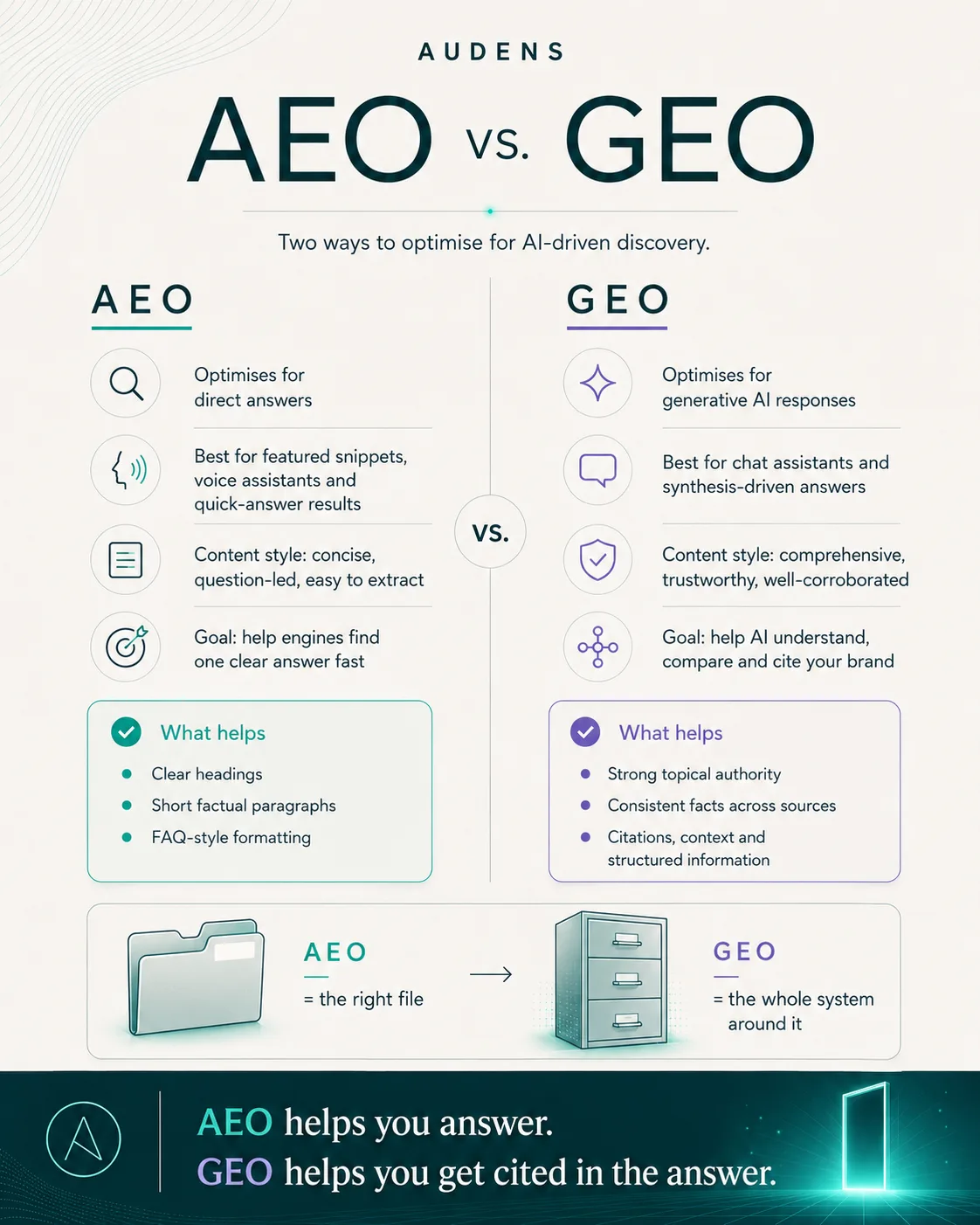
Before we get into what AEO and GEO are, we must look at where exactly it is being used.
The Uses of AEO and GEO Mechanics
AEO is used primarily to optimise for direct-answer surfaces. These can vary from voice assistants like Siri and Alexa to featured snippets, and overviews.
GEO on the other hand, is used to optimise content for generative chat assistants that have lengthier and more in-depth conversations with the user. This mechanism is usually used to influence engines like Grok, Gemini, Claude and ChatGPT.
Now that we know where this optimised content sits in regard to the method used, we can get an understanding of the depth in which the two processes work.
AEO
So, now we know where AEO material sits but what does it really mean to be answer engine optimised? When we ask Alexa, Siri or Google voice assistants a question, their replies vary from yes/no to a short, one-sentence answer that directly addresses the query posed. AEO content makes it easier for the AI crawler of that answer engine to easily spot and retrieve the relevant information.
What does that look like?
"At X brand, we believe every runner deserves footwear engineered to perform, and our commitment to innovation has led us to create some of the most advanced cushioning technologies the industry has ever seen."
Versus
"_X brand product’s_ midsoles typically last 300–500 miles before cushioning breaks down; runners should replace shoes once they notice flattened tread or new joint soreness after runs."
The first sentence talks about the brand feel, the emotional motivation to strive for better engineered products and a commitment to the customer base. The second sentence names the product, gives you insightful and tangible information about the product’s usage plus, a follow-up fact on maintenance/replacement. To a human reader, both look like equally valuable pieces of information being provided. To an AI crawler, only one of these sentences is worth quoting.
The second sentence gives data based in fact that can be re-checked, names the specific product not just the brand and directly answers questions a customer may possibly have in terms of replacement, maintenance, and durability. All of these facts in a single sentence would be able to answer multiple questions of differing intent. The AI crawler doesn’t have to guess intent or move to another source, all the information is plainly available and ready to be quoted.
The problem with the first sentence was it talked about vague, subjective feelings and motivations that cannot be backed by any data. Therefore, unusable to an engine that needs to answer specific questions.
Writing content in a question-answer style, placing it under the right heading, a stand-alone, concise and informative paragraph creates material that is explicit and extractable is foundational to AEO.
GEO
Generative Engine Optimisation is an umbrella term used to define the combination of mechanisms in action to influence Generative AIs. To be quoted by AI engines, whether live retrieval systems or Large Language Models, your content must use Search Engine Optimisation ranking mechanics for AI bot crawlers to notice it; must include Answer Engine Optimisation processes so that the crawler can retrieve the relevant information for the engine; and cross reference it against the Large Language Model Optimised dataset present in the engine as well as live crawls across the web to corroborate whether the information is factually correct before it is cited.
Think of AEO as organising content in a labelled file pertaining to a certain subject matter. GEO organises content in terms of filing cabinets, sections, archives and within those cabinets are the labelled files waiting to be referred.
Closing that gap for a brand, from the audit through to the engineering, is the work we do under AI Visibility.
Sources
- Aggarwal, P. et al., “GEO: Generative Engine Optimization,” KDD 2024: the paper that named and defined GEO, and backs the framing of a generative engine as retrieval plus synthesis. It is also the empirical basis for this article’s central example. The authors found keyword density had minimal effect on citation likelihood, while statistics, cited sources and quotations from credible authorities lifted visibility by up to 40 per cent. arxiv.org/abs/2311.09735
- Google Search Central, “Featured Snippets and Your Website”: official documentation, backs the featured snippet and People Also Ask references as direct-answer surfaces. developers.google.com/search/docs/appearance/featured-snippets
- Google Search Help, “How Google’s featured snippets work”: backs the link between short extractable answers and spoken or mobile queries, which is this article’s bridge from snippets to voice assistants. support.google.com/websearch/answer/9351707