
Schema Markup, Explained: Why Machines Can’t Take Your Word For It
Schema markup is a small block of structured code added to a webpage that tells a machine, explicitly and unambiguously, what each piece of content actually is (“this is a price,” “this is a review score,” “this is the author,” “this is a step in a recipe”) instead of leaving the machine to guess that from surrounding sentences. It doesn’t change what a human sees on the page. It changes what a machine understands about the page, which is precisely why it’s become one of the quiet foundations of GEO.
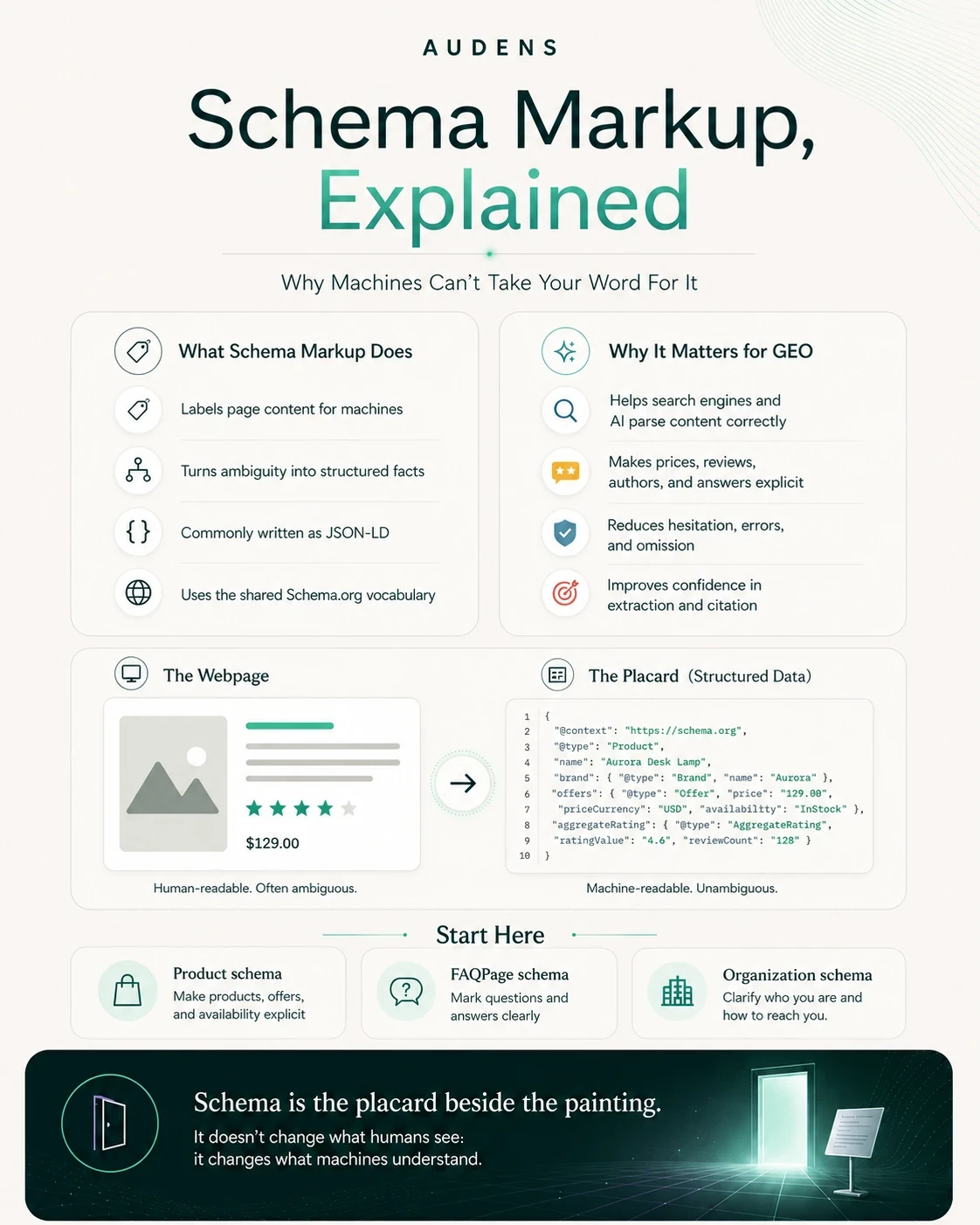
Most brand teams have shipped a website with beautiful copy, a confident tone, and zero schema markup, and assumed the content was doing its job because a person reading it would immediately understand it. The problem is that a language model, a search engine, or an AI assistant doesn’t read the way a person does. It parses. And parsing without labels is a much shakier business than most marketers realise.
The Museum Placard Problem
Imagine walking into a museum and finding a painting hung on the wall with no placard beside it: no title, no artist, no date, no medium. You can still appreciate the painting. You might even guess correctly that it’s a 19th-century oil portrait. But you’re inferring, not knowing. Now imagine that same painting with a small printed placard: Artist, Title, Year, Medium, Dimensions. Nothing about the painting itself changed. What changed is that anyone walking past (including someone in a hurry, including someone who doesn’t read the wall label language fluently, including a machine cataloguing the museum’s collection) now has zero ambiguity about what they’re looking at.
Schema markup is the placard. Your webpage is the painting. Humans have always been reasonably good at appreciating the painting without the placard. Machines are not, and increasingly, it’s machines (search engines, AI models, voice assistants) that decide whether your painting gets shown to anyone at all.
What Schema Actually Does, Technically
At its simplest, schema markup uses a shared vocabulary called Schema.org, written in a format most commonly seen as JSON-LD, embedded invisibly in a page’s code. If a page is reviewing a product, Product schema tells a machine exactly where the price sits, what the review score is, whether it’s in stock. If a page is an FAQ, FAQPage schema tells a machine exactly which sentence answers which question: no interpretation needed, no risk of the machine picking the wrong paragraph. If a page belongs to a company, Organization schema tells a machine the official name, the founding date, the logo, the social profiles. Cleanly, once, unambiguously.
None of this is copy. None of this is visible to a visitor scrolling the page. It sits underneath, quietly doing translation work between “how humans write” and “how machines confirm facts.”
Why This Matters More Now Than It Did Five Years Ago
For most of SEO’s history, schema markup was a nice-to-have. It earned you a slightly fancier-looking search result, a star rating shown under a blue link, maybe a featured snippet. Useful, but marginal.
That calculus has changed, because the machines reading your schema today aren’t just deciding how to display a link. They’re deciding what to say, in their own voice, as a direct answer to someone’s question. Increasingly, they do that without sending the person to your page at all. When an AI model is generating an answer about “which running shoe brand has the best cushioning for marathon training,” it is under real pressure to be fast and to be right. A page with clean Product schema, clear specification fields, and an FAQ block with unambiguous Q-and-A pairs is a page the model can lift a confident fact from in milliseconds. A page saying roughly the same thing in flowing, adjective-heavy prose is a page the model has to interpret, and interpretation is exactly where hesitation, error and (worst of all) omission creep in.
Put simply: schema doesn’t make an AI model like you more. It removes the excuse for the model to skip you because it wasn’t sure.
A Live Example: The Skincare Category
When we ran an AI-visibility assessment across the Indian skincare category, a recurring pattern showed up on the technical side as much as the narrative side. Brands like Minimalist, which are unusually disciplined about publishing precise, consistent ingredient percentages and claims (the kind of specific, structured information that maps naturally onto Product and FAQ schema), turned up in AI-generated answers with confidence and accuracy. Brands whose product pages leaned entirely on mood-board copy and adjectives, with no structured specification anywhere on the page, were far more likely to be paraphrased vaguely or left out of a direct comparison entirely, even when the underlying product was genuinely strong.
The lesson wasn’t “write worse prose.” It was “give the machine a version of the truth it doesn’t have to guess at, sitting right alongside the prose a human enjoys reading.”
Where Schema Sits Among the Basics
If SEO is about ranking, GEO is the umbrella goal of being visible and accurate inside AI-generated answers, AEO is about structuring content to be extracted as a direct answer, and LLMO is about shaping how a model learns about you over time, then schema markup is the connective tissue underneath all three. It’s the most concrete, most immediately actionable of the four, because unlike LLMO, you don’t have to wait for the next training run to see the effect, and unlike broad content strategy, it can often be implemented on an existing page without rewriting a word of copy.
Where to Start
You don’t need every schema type on day one. Start with the pages doing the heaviest lifting: product pages get Product schema with clear price and specification fields, FAQ sections get FAQPage schema, your homepage and about page get Organization schema with your official name and details locked in consistently. Test what’s already there using Google’s Rich Results Test, fix what’s broken or missing, and treat it as ongoing maintenance rather than a one-time project, the same way you’d never let your actual product specifications go stale on a shelf label.
The placard doesn’t replace the painting. But without it, don’t be surprised when the person walking past, human or machine, keeps moving toward the wall that took the time to explain itself.
Sources
- Google Search Central, “Intro to How Structured Data Markup Works”: official documentation, backs the JSON-LD and structured-data explanation. developers.google.com/search/docs/appearance/structured-data/intro-structured-data
- Schema.org: the shared vocabulary maintained by Google, Bing, Yahoo and Yandex, backs the Product, FAQPage and Organization schema references. schema.org
Methodology: the Indian skincare example draws on AUDENS’ own AI-visibility assessment, cross-referencing schema implementation against AI-generated answer accuracy.