
Prompted, Week One: SUGAR Cosmetics Cracked Discovery, Not Identity
Welcome to Prompted, the weekly brand audit column on The Canonical. Each week we take one company, run it through a live, multi-model AI visibility test, and show exactly where what AI says about a brand differs from what the brand says about itself. Week one: SUGAR Cosmetics.
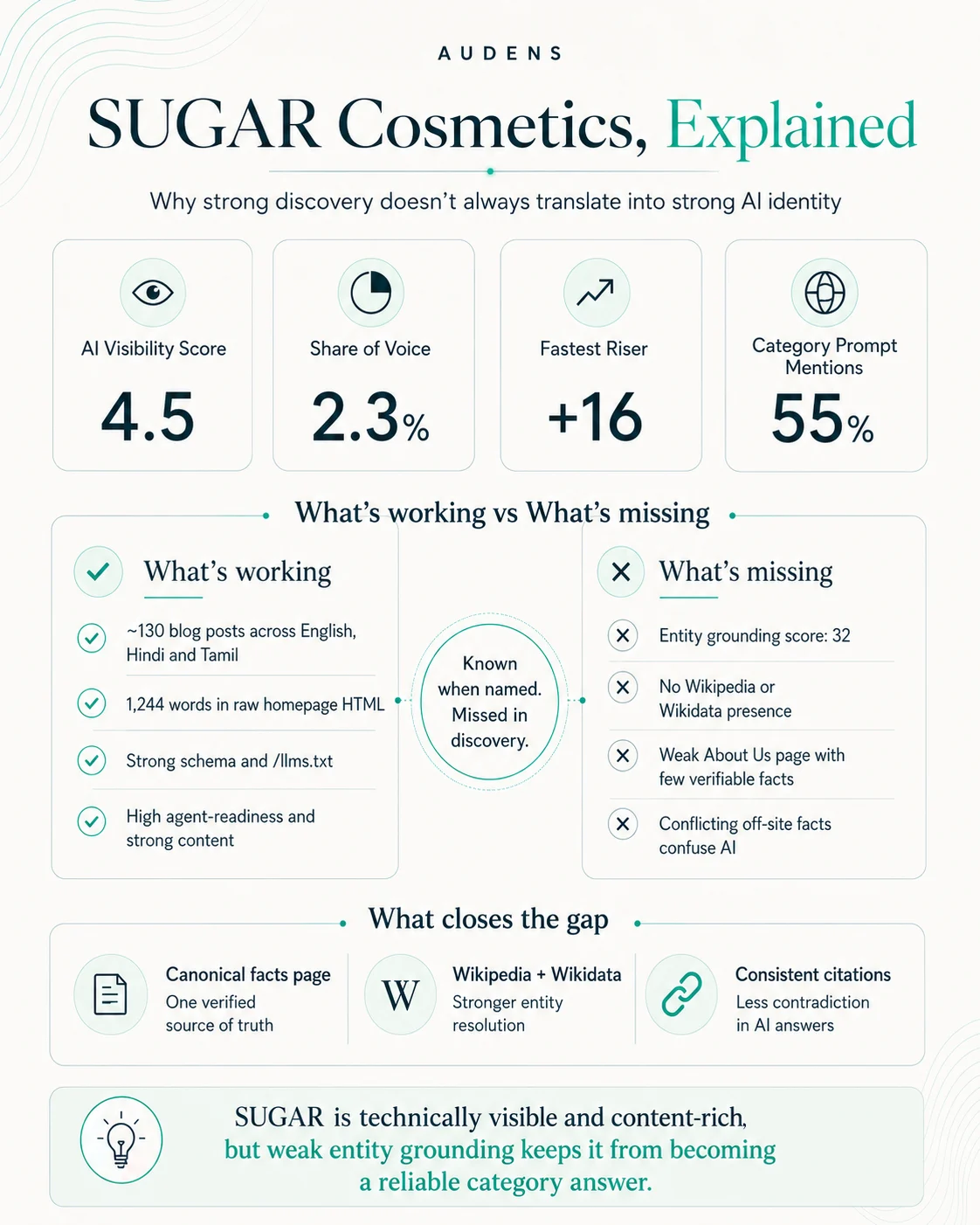
Overview: SUGAR Cosmetics ranks 5th of 6 major Indian beauty brands on AI visibility, despite being the financial quarter’s fastest riser. Its blog outperforms Nykaa’s on raw crawlability. But it has no Wikipedia article, no Wikidata entry, and a 130-word About Us page with zero verifiable facts, so the open web has quietly filled the gap with two contradictory sets of financials, and four different AI models are unable to reach consensus.
Welcome to Prompted, the weekly brand audit column on The Canonical. Each week we take one company, run it through a live, multi-model AI visibility test, and show exactly where what AI says about a brand differs from what the brand says about itself.
Week one: SUGAR Cosmetics.
All figures captured 12 August 2026. Generative engines update continuously, so results are a snapshot of that date and will shift over time.
The number that started this
Press coverage puts SUGAR’s valuation between ₹1,400 and ₹1,500 crore and its colour cosmetics market share near 6.5%. No two sources agree on where those figures came from, which is exactly the problem.
On the AI Visibility Index for Indian skincare and beauty, SUGAR sits at rank 5 of 6, with a visibility score of 4.5( composite score,0-100,measuring a brand's mention in AI answers) and 2.3% share of voice(percentage of AI mentions relative to competitors in the industry). Attached to that low rank is a strange badge: the quarter’s fastest riser. A brand can climb the table and still be nearly silent in the answers that matter.
That contradiction is the whole story here, so we went and tested it ourselves: 40 real prompts, split evenly between people naming SUGAR outright and people just asking about the category, run live across Claude, GPT, Gemini and Grok. 160 model responses in total, cross-checked against a full technical crawl of sugarcosmetics.com benchmarked against five industry competitors.
The gap to the leader
We scored six brands from the same industry category as Sugar against GEO weights that broadly define AI visibility.
- agent readiness
- structured data
- entity grounding
- answer shaped content
- editorial citation
- review coherence
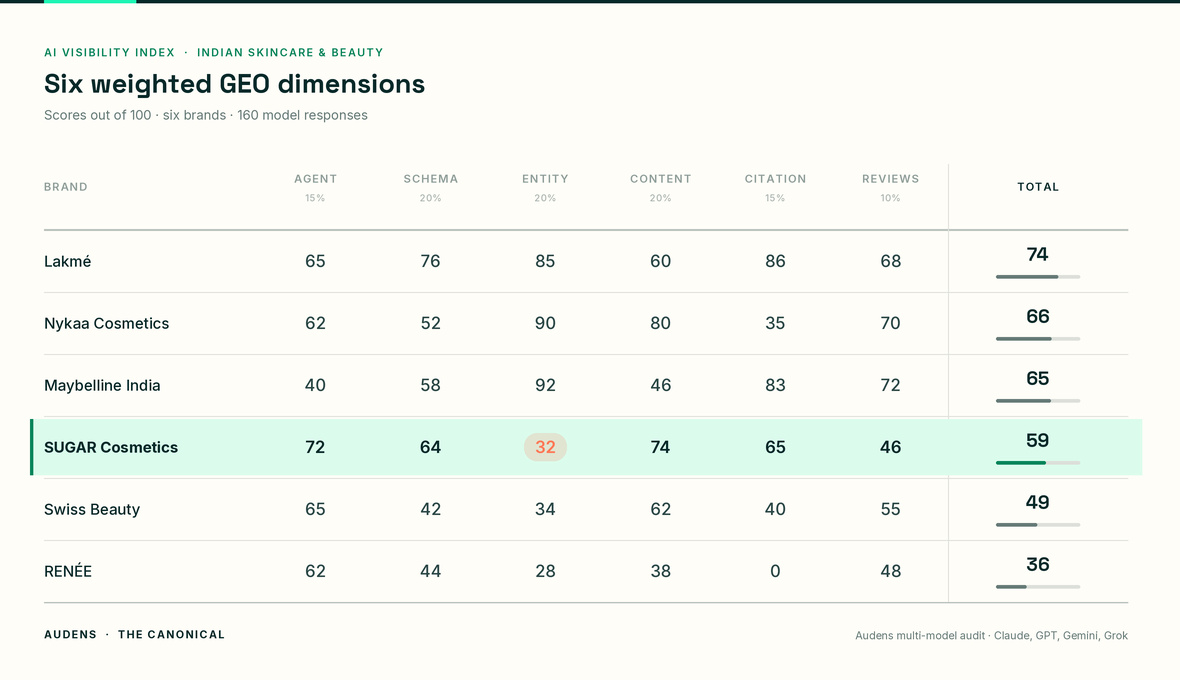
SUGAR has the highest AI agent-readiness score in the entire set and the second-highest content score. What drags it to 5th place is almost entirely one aspect: entity grounding. At 32, the worst of every scaled brand tested. That single dimension carries a 20% weight, making it the most expensive line on the whole chart.
What SUGAR is actually doing right
Start with the part nearly every D2C brand fumbles: SUGAR’s blog is a genuine answer engine, not a content-marketing costume. It runs roughly 130 posts across English, Hindi and Tamil, structured as comparison listicles with author bylines, publish dates and comparison tables. Search “affordable cruelty-free makeup brand India under 500” and SUGAR’s own posts land at #1 and #2, ahead of Myntra’s blog and LBB. One post, a 1,646-word rundown of the best cruelty-free brands under ₹1,000, does the thing almost nobody will: it names nine competitors by name, including Plum, Colorbar, Faces Canada and RENÉE. That’s precisely why it gets retrieved. It reads like an evaluator, not a sponsored article.
The site is also genuinely more machine-readable than you’d expect from a beauty-oriented company. SUGAR’s homepage delivers 1,244 words in raw HTML before a single line of JavaScript runs. Nykaa’s delivers 161. Most AI crawlers never execute JavaScript, so on a purely technical level, SUGAR is more visible to a model today than India’s largest beauty platform. Product pages carry proper schema (Product, aggregate, Rating, Offer, brand, SKU), the FAQ page carries FAQPage markup, and the homepage carries Organization, WebSite and BreadcrumbList. With the potential addition of a live /llms.txt file and working Universal Commerce Protocol endpoints, and a shopping agent can actually browse, build a cart and check out on sugarcosmetics.com with ease directly on behalf of a customer. Maybelline India’s /llms.txt returns a 404. On the infrastructure GEO is built on, SUGAR is ahead of brands several times its size.
Our live test confirms it, ask Claude, GPT, Gemini or Grok direct, branded questions (is SUGAR good for oily skin, is it cruelty-free, where can I buy it) and the brand shows up in every single response, across all four models, with specific shades, specific formulas, specific ingredient claims cited. When someone already knows to ask about SUGAR by name, every model has plenty to say.
Where it quietly falls apart
The moment a prompt stops naming the brand, the story flips. We ran the same test using category prompts instead, the kind people actually type: “best budget makeup brands in India,” “best transfer-proof lipstick under ₹700.” Across the whole implicit set, SUGAR’s mention rate dropped from 100% to 55%. Nearly half the time, in the exact discovery moment SUGAR should be winning, it just isn’t part of the answer.
Break that down by topic and it gets pointed. Ask an AI which brands stock franchise or distributorship opportunities and SUGAR is named in zero of four responses, despite running an active franchise programme. Ask which makeup “survives Delhi summer heat and humidity,” a claim that sits at the center of SUGAR’s own product marketing, and it’s mentioned in one response out of four. The brand that built its formulas for Indian climates is the one AI forgets when someone asks about Indian climates.
The provider split matters too. Gemini left SUGAR out of category answers most often, missing it more than half the time, while Claude was the most generous and still skipped it more than a third of the time.
The mechanism behind all of this is simple. SUGAR has no Wikipedia article and no Wikidata item; founder Vineeta Singh has one however, the brand doesn’t. Wikidata is part of the scaffolding language models use to resolve what an entity even is, so without an entry, SUGAR reads to a model less like a company and more like a website it happens to have crawled. The About Us page doesn’t help: about 130 words of “a brand of choice for the women of today,” curating products “from around the globe,” with no founding year, no founder names, no store count, no certifying body for the cruelty-free claim it makes elsewhere. It also quietly contradicts the founder’s own homepage message about building specifically for Indian women rather than importing from abroad. A model reading both pages has nothing consistent to repeat back.
Into that vacuum, the open web has supplied its own answer, or rather several, none of them official. Search SUGAR’s FY24 financials and you’ll find a ₹18 crore profit on one site and a ₹67.5 crore loss on another, both stated flatly as fact. A journalist reading four contradictory testimonies at least knows to be suspicious. A model asked “how is SUGAR performing financially?” has no such instinct. It just picks one and states it with confidence.
Third-party sentiment tells the same story. SUGAR’s own sampled product reviews sit at 4.40 out of 5. Off-site, where models actually go looking, MouthShut shows 2.38 and PissedConsumer carries 184 unresolved complaints, and our citation data confirms models are pulling directly from that source: PissedConsumer showed up as a cited domain in the very first prompt of our test. Across the 160 responses in this test the domains models cited were overwhelmingly earned and third-party, with sugarcosmetics.com supplying a small fraction. Owned pages still decide what those third parties have to work with. The 2.38 is the number that keeps getting repeated, not the 4.40.
And in the actual category listicles that generative engines retrieve for “best makeup brands in India,” SUGAR shows up in all five tested, same as Lakmé and Maybelline. The difference is where SUGAR’s average rank across those five lists is 5.6, Lakmé’s is 2.8, Maybelline’s is 3.2. When a generated answer names the top three brands in a category, being consistently ranked fifth is functionally the same as being invisible.
What the gap actually costs
SUGAR spent ₹168 crore on marketing in FY25 against ₹412 crore of revenue, roughly 41 paise of marketing for every rupee earned, while total costs pushed the year to a widening ₹135 crore net loss. An entity page and one canonical facts page aren’t just SEO housekeeping. They are a far cheaper place to start than the line currently absorbing ₹168 crore a year, and they are the groundwork independent references get built from. A brand this fluent in content shouldn’t be this illegible as a fact.
Next week on Prompted: We run the same test on another popular brand to test how that popularity translates to their AI presence. See the difference in their AI share of voice when a brand is explicitly named as compared to implicit prompting.
Sources
- Storyboard18 / The Arc, Oct 2025: FY25 net revenue ₹415 crore, down 17.8% year on year, EBITDA margin -26%. storyboard18.com/brand-marketing/sugar-cosmetics-profitability-slips-as-fy25-revenue-declines-to-rs-415-crore-82535.htm
- Startuppedia (RoC filings), May 2026: FY25 revenue ₹412 crore, net loss ₹135 crore, ad spend ₹168 crore. This is the basis for the ₹168 crore spend, ₹412 crore revenue and ₹135 crore loss figures used above.startuppedia.in/trending/startup-news/iim-ahmedabad-couple-led-sugar-cosmetics-reports-rs-412-cr-revenue-in-fy25-amid-rising-losses-11442360
- Inventiva, June 2026: corroborates the FY24 and FY25 revenue and loss trajectory.
Methodology: 40 prompts synthesised from real user questions and intent clusters, split evenly between explicit (brand-named) and implicit (category-only) sets, run across Claude, ChatGPT, Gemini and Grok for 160 responses in total. All data captured 12 August 2026; model outputs are non-deterministic and subject to change.