
LLMO, Explained: Why Being Trained On Isn’t the Same as Being Understood
LLMO (LLM Optimisation) is the practice of shaping how your brand exists in the data that large language models learn from and pull from, so that when a model forms an “opinion” about your category, it forms an accurate one about you. It sits underneath GEO the way plumbing sits underneath a building: invisible when it works, catastrophic when it doesn’t.
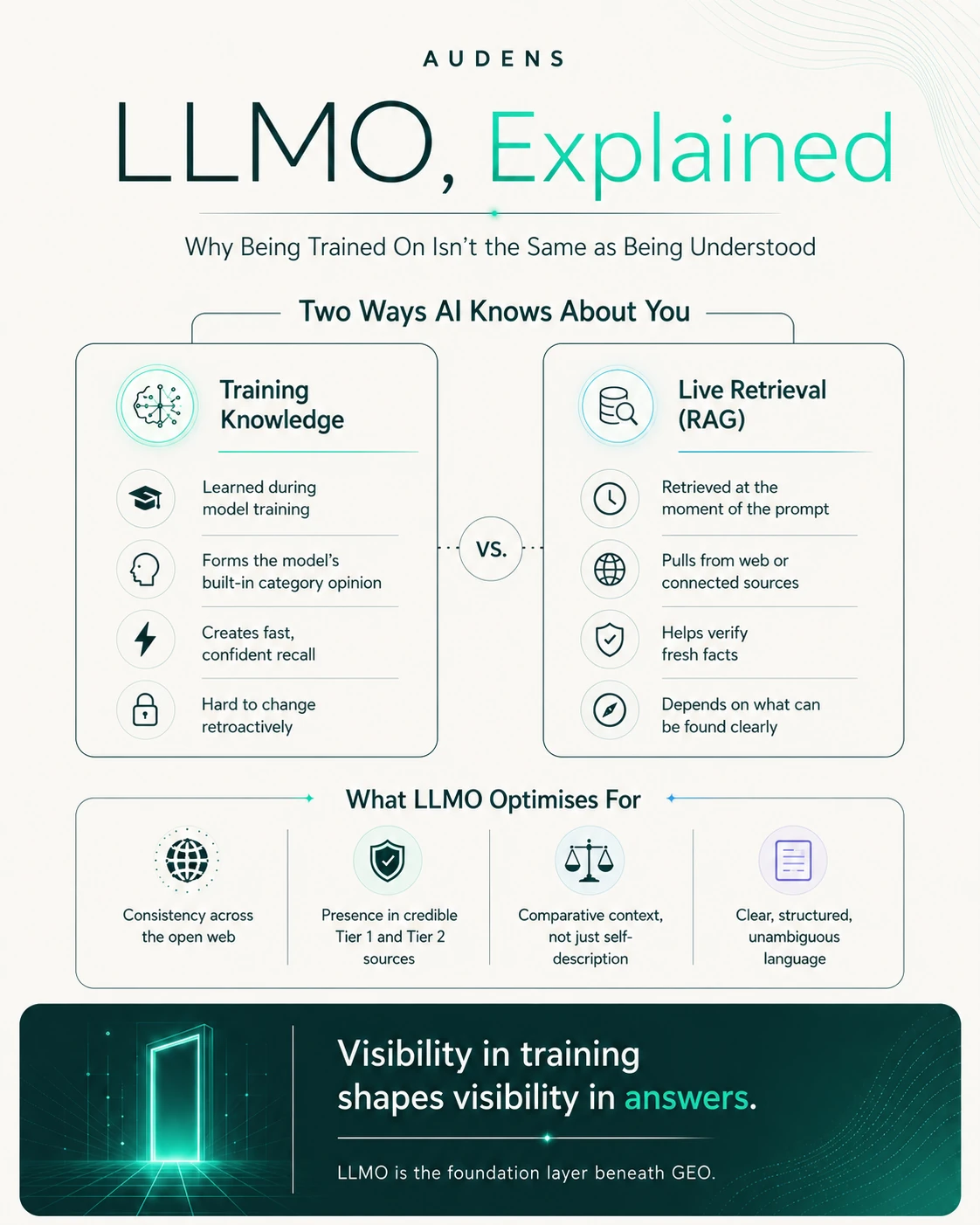
Most brand teams have heard of SEO. A growing number have heard of GEO. Almost none have a clear picture of LLMO. And yet it’s arguably the most foundational layer of all three, because it deals with the substance a model actually learned from, not just the pages it might retrieve later.
Two Different Ways an AI “Knows” About You
Every large language model has two distinct ways of knowing something. The first is what it learned during training: a compressed, generalised understanding baked into the model itself, formed from enormous volumes of text it read once, long before you ever typed a prompt. The second is what it retrieves live, through web search or a connected database, at the moment you ask a question. That process is called RAG (Retrieval-Augmented Generation).
LLMO is concerned with the first kind of knowledge. It’s the difference between a doctor who genuinely studied cardiology for years and a doctor who’s frantically googling your symptoms mid-consultation. Both might land on a correct answer. But the one who studied it has faster, more confident, more consistent recall, and doesn’t need to double-check basic facts every single time. LLMO is the discipline of making sure that when a model “studied” your industry, it studied you correctly.
GEO, by contrast, spans both. It cares whether you show up well in training and in real-time retrieval. AEO is narrower still, focused on structuring content so a specific answer can be extracted cleanly, in either scenario. LLMO is the deepest layer: it’s about the raw material itself, long before any prompt is typed.
Why This Matters More Than It Sounds Like It Should
Here’s the uncomfortable part for most brands: you cannot directly edit what a model learned. There’s no dashboard, no “submit your brand facts here” form, no equivalent of Google Search Console where you nudge a ranking. The training data for a large model was scraped from the internet at a point in time, and whatever was true, false, outdated, or simply absent about your brand at that moment is now compressed into the model’s weights, where it quietly shapes every answer it gives about your category, possibly for years.
This is why a brand can have excellent SEO, a beautifully designed website, and still get consistently mischaracterised, underrepresented, or left out entirely when someone asks an AI model to recommend a product in their category. The website is not the problem. What existed about the brand across the wider web (review sites, forums, comparison articles, Wikipedia, press coverage, industry roundups) at the time of training is the problem. Or the opportunity, if it’s done right.
An Analogy Worth Sitting With
Literature has already solved this problem for us, long before anyone coined the term LLMO. It’s called canon formation, and it explains LLMO better than any tech metaphor can.
Herman Melville published Moby-Dick in 1851 to poor sales and mixed reviews, and spent the rest of his life largely unread as a novelist. He did not become “canonical” (required reading, endlessly cited, the default reference for American literature) until decades later, when critics, anthologists, and university syllabi started citing him again and again, in consistent terms, across enough credible venues that the reputation compounded. Meanwhile, several of Melville’s contemporaries outsold him ten to one in their own lifetimes and are barely read today, because nobody kept re-describing them consistently enough for that description to calcify into common knowledge.
A language model builds its “opinion” of your brand the same way a literary canon gets built: not by who sold the most in the moment, but by who got described, cited, and cross-referenced consistently enough, by credible enough sources, for that description to harden into settled fact. Being popular once is not the same as being canonical. Being canonical is what survives into the default assumptions of the next reader, or the next model.
This is precisely the outcome we mean when we talk about becoming the canonical brand in a category: not the loudest, not even necessarily the best-selling, but the one whose story was told clearly and repeatedly enough, by sources worth citing, that it became the default the model reaches for without hesitation. LLMO is the deliberate, unglamorous work of canon-building for the AI era. It means getting your brand cited consistently enough, in credible enough company, that it stops being one version among many and becomes the version.
What LLMO Actually Looks Like in Practice
It is not one tactic; it’s a discipline built from several habits, most of which have nothing to do with your own website:
Consistency across the open web. If your product specifications, positioning, and claims are described five different ways across five different sources, a model has no single confident version to learn. Say the same specific thing about yourself, in the same specific language, in as many credible places as possible.
Presence in Tier 1 and Tier 2 sources. Models learn from a curated slice of the web, and what survives that curation is the material with independent corroboration behind it: encyclopaedic references, established publications, well-cited comparison content. A brand that exists only in its own adjectives and paid listicles gives a model nothing independent to learn from, and nothing independent means nothing safe to repeat.
Comparative context, not just self-description. Models learn categories relationally. “X is positioned as the affordable alternative to Y” is far more useful training signal than “X is the best.” Brands that appear inside genuine comparative content (reviews, roundups, analyst notes) get encoded with useful, specific context. Brands that only appear in their own adjectives get encoded with almost nothing usable.
Structured, unambiguous language. This is where schema markup and clean factual writing matter even for LLMO, not just for live retrieval. The clearer and more specific a fact is written, the more reliably it’s absorbed rather than blurred together with a competitor’s.
A Live Example
All figures captured 27th July 2026. Generative engines update continuously, so results are a snapshot of that date and will shift over time.
When we ran an AI-visibility read on the Indian skincare category at Audens, one pattern stood out immediately: brands like Minimalist had a specific, consistent ingredient-and-claims story repeated across enough credible sources that models could recall it confidently and correctly. Meanwhile, several genuinely good products in adjacent segments (say, premium anti-aging) had almost no confident model recall at all, not because the product was weak, but because there simply wasn’t enough consistent, comparative, credible material about them anywhere a model would have learned from. That’s not a marketing failure in the traditional sense. It’s an LLMO gap.
Where This Leaves Marketers
LLMO forces an uncomfortable but useful realisation: your AI reputation was substantially decided before you ever started paying attention to it, by everything that was ever written about you across the web, weighted by how credible the source was. You cannot retroactively edit a model’s training data. But you can influence the next one, and you can course-correct current models’ live retrieval behaviour through the GEO and AEO work built on top of this foundation.
The practical starting point is almost always the same: ask a handful of AI models directly what they believe about your brand and your category today. What comes back is, in effect, a report card on your LLMO, written by the very system you’re trying to influence. The good part is most generative engines are a combination of LLMs and cloud-based live retrieval models that function as an intermediary between the training set and current, fresh information. So, while your image in the training set may be unfavourable, or worse yet invisible, enough information pertaining to your category and entity domain of your brand will get you noticed.
Stay tuned to The Canonical to know more about why, how and where to leverage live models to your brand's advantage.
Sources
- Lewis, P. et al., “Retrieval-Augmented Generation for Knowledge-Intensive NLP Tasks,” NeurIPS 33 (2020): backs the distinction between training knowledge and live retrieval. arxiv.org/abs/2005.11401
- Melville, Moby-Dick (1851) and its documented critical rediscovery: backs the canon-formation analogy.